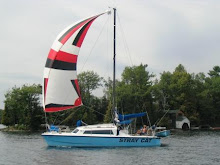
Sunday, November 22, 2009
Last Post
For further adventures of the R&B Haven, please go to http://rbhavenadventures.blogspot.com . There, you will our trip as we head South to Florida and then to the Bahamas.

Friday, April 3, 2009
What is it like?
There I am - nestled in on the leward side. The wind picks up slightly. The boat heels over a little more. I feel the pressure in the helm as the boat tries to head up. I let it as it works its way over the top of a swell. Then I lay off slightly to power up and to build back speed. I note that the jib sheet has stretched a little in response to the increased wind pressure. If the wind stays this way, I will tighten the sheet a few clicks to help us point. I glance at the main. All 4 tell-tales are streaming out from the leach although the upper one is trying to curl back.
I am at one with the wind, the boat and the sea.
Then Bev shakes me. Wake up, wake up. It is almost dawn and we have 80 nautical miles to cover before we anchor today.
I groan. I step into my clothes and then take to dogs to the cockpit so that they can do their business on their "welcome mat". They have given new meaning to the expression, "the poop deck".
I start the generator and fire up the coffee maker. I check for water in the exhaust and note voltages and charge rates. I know that engine and generator fluid levels are OK because I checked them last night before turning in. I turn on the instruments and start booting the computer. I retrieve the dogs and check their food and water. I start the main engine and check its exhaust for water as well. The coffee is almost ready. Bev has started her shower.
I go to the upper helm station and pull covers off instruments and open the front window of the flybridge enclosure for better visibility. I make sure the computer screen is displaying navigational charts, our position, speed etc from the computer below.
By now the coffee is ready and Bev is slipping bagels into the toaster.
I return to the upper helm station and, using the remote windlass buttons, hoist the anchor. We will attach its safety line later. There is light but the sun has not yet risen. I turn out the masthead anchor light and turn on the navigation lights.
I slip the engine into gear. At 1000 rpm (idle is at 800 rpm), we thread our way out of the anchorage at 5 knots. Once we hit the channel, I nudge the throttle to 1200 rpm and we pick up speed to 6 knots. We still have very little wake. There are other boats anchored just off the channel and I don't wish to disturb them. At this speed, we probably burn about 1.1 gallons per hour.
As soon as we clear the last boat, I nudge the throttle again, to 1450 rpm. We are bucking a very slight chop. Our speed is 6.8 knots. We are now burning 1.9 gallons per hour and getting about 3.5 nautical miles per gallon. In a flat calm, we might do 7 knots at the same rpm.
As we round the point and hit the open sea, I contemplate how far we have to go and at what time we might arrive. The previous owners cruised at 1700 rpm. In a calm, they would hit 8 knots but I know that today, we would probably only hit 7.8. Our mileage would drop to about 2.5 mpg.
While I am contemplating this, I note that the exhaust note has changed. The bagels are finished and Bev has turned off the generator. The Perkins, although much larger and much more powerful than the Onan generator, is comparatively very quiet.
As I lock in the autopilot, Bev arrives on the flybridge with hot buttered bagels. We discuss arrival time vs fuel consumption. The last time we filled up. diesel was $2.05 per gallon so if we travel 1 knot faster, we will save 1.5 hours but spend $18 more in fuel. Today, we have no incentive to arrive early, so we opt to travel more slowly. Another day, at these fuel prices, the decision might be different.
Now that theses decisions are out of the way, except for keeping a lookout for other vessels and for crab pot floats, we have nothing to do for the next 11 hours or so.
Did I mention that driving one of these things is kind of boring. It's like driving a RV down the middle of a 6 lane highway with absolutely no other vehicles at 15 kilometers per hour. You still have to pay attention, but really, there is absolutely no challenge. Did I mention that it is boring. Well, its really boring. If you get into a good book, Murphy's law makes it certain that a crab pot float will sneak up on your propeller. There is nothing to do, but you still have to pay attention.
So, the challenge of using the forces of nature to conquer the sea is no longer the point. The point is to have the luxuries of home in exotic and remote locations. After all, you can rent a lot of hotel rooms in pedestrian locations for way less than the cost of owning a boat.
In this way, trawler boating is similar to RVing. Paying $95 per night to park a RV in a really terrible campground in Las Vegas would be stupid. Paying $10 per night to park a RV in a remote campground with no services but located at the top of a cliff overlooking the Grand Canyon is priceless.
So what else is it like you ask?
There is an old saying that "if Moma ain't happy, ain't nobody happy". Moma is ecstatic. That is the good side and it is a very good side.
So what is the price? There is an old axiom that simple things simply tend not to break. Compared to any boat I have ever owned, this thing is incredibly complex. My friend, Bob Williams, informs me that compared to his boat, ours is very simple. Still, there is a lot here that can go wrong and most of it has not been new since 1981!
The marine surveyor left me with a list as long of my arm of things that needed to be fixed. None of it was hugely expensive, but it all takes time. Because most of the equipment on the boat is new to me, I am spending a lot of time sifting through manuals trying to figure things out. One of the problems is that although there is a manual for almost every piece of equipment on board, there is no manual for the boat as whole.
Part of the problem is that I believe the boat had been marina serviced. The previous owner was elderly. I believe he was very conscientious, but employees of marinas are sometimes neither so conscientious nor so capable as one might have liked.
Let me give an example. When we did the sea trial, the generator would not start. As part of the deal, the owner had it fixed. The starter was removed, rebuilt and its solenoid was replaced. Reportedly, this cost the owner somewhere in the order of $700 to $800. A few weeks after we took possession of the boat, the generator started to hunt. Fortunately for me, my friend Bob Williams was on board. Being an old motorcycle mechanic, his approach to an electrical problem was to grab a handful of wires, to shake them and to see if anything changes. While doing this, the main power cable to the starter came apart in his hand. He also found that neither of the bolts holding the head of the starter to the generator was tight. In addition, the single bolt at the other end of the starter was entirely missing. The loose electrical cable not only explained why the generator had started to hunt but why it had failed to start at all for the previous owner.
So here we have a situation where a conscientious owner had paid a lot of good money to have a problem fixed, but the "fix" had left the situation worse than it was before. To add insult to injury, inspection of the cable showed that about 6 inches from where it attached to the starter, the main power cable had chafed through its insulation and had arced half way through the copper. This was a major fire just waiting for the right time to happen.
Even an incompetent mechanic (like me) should have been able to do better!
All of this is to say that I plan on spending a lot of time maintaining this boat.
What else is it like?
The storage areas are the pits.
Comfort is great.
The generator is noisy, but I think I can do something about this.
The generator must be run a lot. Part of the problem is that the boat is really designed for marina living. For example, when you turn on a switch, it energizes 6 lights - not just one and there are lots of incandescent lights on this boat.
What about rolling? The boat has hard chines and so it probably rolls less than some. When you are in the upper steering station, however, your head is about 16 feet off the water. Even when the boat rolls a little, you move sideways a lot and so you really feel it.
The movable furniture really does move. This is great when in harbour but can be less than great at sea. Unless something is restrained, if you don't put it on the floor when you leave port, chances are that it will be on the floor and broken when you get to your destination.
I am at one with the wind, the boat and the sea.
Then Bev shakes me. Wake up, wake up. It is almost dawn and we have 80 nautical miles to cover before we anchor today.
I groan. I step into my clothes and then take to dogs to the cockpit so that they can do their business on their "welcome mat". They have given new meaning to the expression, "the poop deck".
I start the generator and fire up the coffee maker. I check for water in the exhaust and note voltages and charge rates. I know that engine and generator fluid levels are OK because I checked them last night before turning in. I turn on the instruments and start booting the computer. I retrieve the dogs and check their food and water. I start the main engine and check its exhaust for water as well. The coffee is almost ready. Bev has started her shower.
I go to the upper helm station and pull covers off instruments and open the front window of the flybridge enclosure for better visibility. I make sure the computer screen is displaying navigational charts, our position, speed etc from the computer below.
By now the coffee is ready and Bev is slipping bagels into the toaster.
I return to the upper helm station and, using the remote windlass buttons, hoist the anchor. We will attach its safety line later. There is light but the sun has not yet risen. I turn out the masthead anchor light and turn on the navigation lights.
I slip the engine into gear. At 1000 rpm (idle is at 800 rpm), we thread our way out of the anchorage at 5 knots. Once we hit the channel, I nudge the throttle to 1200 rpm and we pick up speed to 6 knots. We still have very little wake. There are other boats anchored just off the channel and I don't wish to disturb them. At this speed, we probably burn about 1.1 gallons per hour.
As soon as we clear the last boat, I nudge the throttle again, to 1450 rpm. We are bucking a very slight chop. Our speed is 6.8 knots. We are now burning 1.9 gallons per hour and getting about 3.5 nautical miles per gallon. In a flat calm, we might do 7 knots at the same rpm.
As we round the point and hit the open sea, I contemplate how far we have to go and at what time we might arrive. The previous owners cruised at 1700 rpm. In a calm, they would hit 8 knots but I know that today, we would probably only hit 7.8. Our mileage would drop to about 2.5 mpg.
While I am contemplating this, I note that the exhaust note has changed. The bagels are finished and Bev has turned off the generator. The Perkins, although much larger and much more powerful than the Onan generator, is comparatively very quiet.
As I lock in the autopilot, Bev arrives on the flybridge with hot buttered bagels. We discuss arrival time vs fuel consumption. The last time we filled up. diesel was $2.05 per gallon so if we travel 1 knot faster, we will save 1.5 hours but spend $18 more in fuel. Today, we have no incentive to arrive early, so we opt to travel more slowly. Another day, at these fuel prices, the decision might be different.
Now that theses decisions are out of the way, except for keeping a lookout for other vessels and for crab pot floats, we have nothing to do for the next 11 hours or so.
Did I mention that driving one of these things is kind of boring. It's like driving a RV down the middle of a 6 lane highway with absolutely no other vehicles at 15 kilometers per hour. You still have to pay attention, but really, there is absolutely no challenge. Did I mention that it is boring. Well, its really boring. If you get into a good book, Murphy's law makes it certain that a crab pot float will sneak up on your propeller. There is nothing to do, but you still have to pay attention.
So, the challenge of using the forces of nature to conquer the sea is no longer the point. The point is to have the luxuries of home in exotic and remote locations. After all, you can rent a lot of hotel rooms in pedestrian locations for way less than the cost of owning a boat.
In this way, trawler boating is similar to RVing. Paying $95 per night to park a RV in a really terrible campground in Las Vegas would be stupid. Paying $10 per night to park a RV in a remote campground with no services but located at the top of a cliff overlooking the Grand Canyon is priceless.
So what else is it like you ask?
There is an old saying that "if Moma ain't happy, ain't nobody happy". Moma is ecstatic. That is the good side and it is a very good side.
So what is the price? There is an old axiom that simple things simply tend not to break. Compared to any boat I have ever owned, this thing is incredibly complex. My friend, Bob Williams, informs me that compared to his boat, ours is very simple. Still, there is a lot here that can go wrong and most of it has not been new since 1981!
The marine surveyor left me with a list as long of my arm of things that needed to be fixed. None of it was hugely expensive, but it all takes time. Because most of the equipment on the boat is new to me, I am spending a lot of time sifting through manuals trying to figure things out. One of the problems is that although there is a manual for almost every piece of equipment on board, there is no manual for the boat as whole.
Part of the problem is that I believe the boat had been marina serviced. The previous owner was elderly. I believe he was very conscientious, but employees of marinas are sometimes neither so conscientious nor so capable as one might have liked.
Let me give an example. When we did the sea trial, the generator would not start. As part of the deal, the owner had it fixed. The starter was removed, rebuilt and its solenoid was replaced. Reportedly, this cost the owner somewhere in the order of $700 to $800. A few weeks after we took possession of the boat, the generator started to hunt. Fortunately for me, my friend Bob Williams was on board. Being an old motorcycle mechanic, his approach to an electrical problem was to grab a handful of wires, to shake them and to see if anything changes. While doing this, the main power cable to the starter came apart in his hand. He also found that neither of the bolts holding the head of the starter to the generator was tight. In addition, the single bolt at the other end of the starter was entirely missing. The loose electrical cable not only explained why the generator had started to hunt but why it had failed to start at all for the previous owner.
So here we have a situation where a conscientious owner had paid a lot of good money to have a problem fixed, but the "fix" had left the situation worse than it was before. To add insult to injury, inspection of the cable showed that about 6 inches from where it attached to the starter, the main power cable had chafed through its insulation and had arced half way through the copper. This was a major fire just waiting for the right time to happen.
Even an incompetent mechanic (like me) should have been able to do better!
All of this is to say that I plan on spending a lot of time maintaining this boat.
What else is it like?
The storage areas are the pits.
Comfort is great.
The generator is noisy, but I think I can do something about this.
The generator must be run a lot. Part of the problem is that the boat is really designed for marina living. For example, when you turn on a switch, it energizes 6 lights - not just one and there are lots of incandescent lights on this boat.
What about rolling? The boat has hard chines and so it probably rolls less than some. When you are in the upper steering station, however, your head is about 16 feet off the water. Even when the boat rolls a little, you move sideways a lot and so you really feel it.
The movable furniture really does move. This is great when in harbour but can be less than great at sea. Unless something is restrained, if you don't put it on the floor when you leave port, chances are that it will be on the floor and broken when you get to your destination.
The steering is strange. When you turn the wheel, it takes a while before anything happens. When the boat finally starts to turn, you had better start to countersteer right away. Otherwise, you will overshoot. Bucking a head sea is OK but I have found that you don't have to be a drunken sailor to steer like one in a following sea.
So, in summary, it's comfortable, it's going to be a lot of work but Moma is really happy, and if Moma is really happy, I am really happy.
That's what it is all about isn't it?
(Note from Bev) Yes i am really happy.
The galley is wonderful, lots of hot water.it really is a galley for one but close to salon so we can talk as I prepare meals.
The sundeck is the best thing on the boat , next to the fishing cockpit.
I can set up my sewing machine, have people over for dinner, pull up the wicker chairs, need I say more.
When we bring boat home as we are doing my girls can swim from the cockpit, as we will be right there, life is good.
Wednesday, April 1, 2009
what we got
So here we are, at the turning point of our voyage to become trawler trash.
We had a list of what we were looking for. We set out to look at "oldie goldies". Mostly, we saw "mouldie oldies".
We finally found a boat having most of the characteristics we were looking for and the asking price was not too far above what we felt we could afford.
The broker helping us find the right boat had warned us not to appear to be too excited when we saw something we liked. Otherwise, the offer acceptance price just went up.
The boat was what I will call a Gulfstar stretch 38. That is a standard Gulfstar 38 motor cruiser with a 5 foot cockpit added at the back to make the overall length 43 feet.
Bev was ecstatic. Asking her to completely contain her exuberance was like asking a balloon to behave like a 1000 psi pressure vessel. It could not be done. She would have exploded!

This is the standard Gulfstar 38. Ours is similar except that it has the cockpit, a single engine (a perkins 6 cylinder, turbocharged monster sized chunk of cast iron), a bow thruster, 300 gallons of water storage and 250 gallons of fuel capacity.
 As you can see here, our boat also has a cockpit enclosure .

In this photo, you can see the crane for lifting the dingy onto the roof.

This photo was taken at the dock before we took possession. You can see the shade screen on the sundeck (or back porch).


Another shot of the sundeck.
I am not sure if the maroon carpet will stay. It matches the trim on the boat beautifully but it shows the dirt too well.

 The saloon: I really like the comfort of the leather chairs.
Another shot of the saloon looking aft.
 This is the master bedroom (under the sun deck). We wanted a bed with access from both sides but at least it is very comfortable.
 Shelving in the master bedroom. See all those cupboards. Actually, storage is a real challenge on this boat. The potential storage space is just not well used. The sliding drawers provide very little usable volume as compared to what straight shelves might have given.
The wood work is beautiful though.  This is the indoor steering station and has probably never been used.
This is Bev in the galley when we were doing our initial inspection. As you can see, she has her best poker face on so that the broker would not know that she liked it.
 Galley, sink and storage. That lid in the corner is not the top of an ice box. It is where we put pots and pans.
 More of the galley.
We had a list of what we were looking for. We set out to look at "oldie goldies". Mostly, we saw "mouldie oldies".
We finally found a boat having most of the characteristics we were looking for and the asking price was not too far above what we felt we could afford.
The broker helping us find the right boat had warned us not to appear to be too excited when we saw something we liked. Otherwise, the offer acceptance price just went up.
The boat was what I will call a Gulfstar stretch 38. That is a standard Gulfstar 38 motor cruiser with a 5 foot cockpit added at the back to make the overall length 43 feet.
Bev was ecstatic. Asking her to completely contain her exuberance was like asking a balloon to behave like a 1000 psi pressure vessel. It could not be done. She would have exploded!

This is the standard Gulfstar 38. Ours is similar except that it has the cockpit, a single engine (a perkins 6 cylinder, turbocharged monster sized chunk of cast iron), a bow thruster, 300 gallons of water storage and 250 gallons of fuel capacity.
 As you can see here, our boat also has a cockpit enclosure .
In this photo, you can see the crane for lifting the dingy onto the roof.
It has radar, two depth sounders, two radios, a hydraulically actuated autopilot, 2 permanently mounted GPSs (as well as the one tied into our laptop that we use to navigate), twin steering stations, a flat screen TV and two CD-AM/FM stereos.

This photo was taken at the dock before we took possession. You can see the shade screen on the sundeck (or back porch).
We are finding the cockpit to be very handy when at anchor.

The next few photos show the sundeck. It is the main outdoors living area except when under way. The furniture is plastic (wicker) and may be moved as we see fit. I thought it might move about more when under way, but so far that has not happened.

Another shot of the sundeck.
I am not sure if the maroon carpet will stay. It matches the trim on the boat beautifully but it shows the dirt too well.

Final shot of the sundeck showing the entrance to the saloon, the main indoor living area.
I suspect we will not keep the freezer on board. It consumes 14 amps (at 12v) when running. If we assume a 50% duty cycle, we would have to run the generator another 2.5 hours per day when at anchor.
 The saloon: I really like the comfort of the leather chairs.
 All the furniture in the saloon is movable. When we get "waked" by large powerboats, this furniture can move around a fair bit. If things like lamps are not restrained or put on the floor, they will tend to put themselves on the floor.

Another shot of the saloon looking aft.
Access to the motor and generator is via large hatches in the saloon
 This is the master bedroom (under the sun deck). We wanted a bed with access from both sides but at least it is very comfortable.
 Shelving in the master bedroom. See all those cupboards. Actually, storage is a real challenge on this boat. The potential storage space is just not well used. The sliding drawers provide very little usable volume as compared to what straight shelves might have given.
The wood work is beautiful though.
The master bedroom has its own head, complete with bathtub, electrically flushing toilet, sink, mirror, cabinets and sewage treatment system so that in most coastal areas, you do not have to use a holding tank.
 This is the indoor steering station and has probably never been used.
 There are some nice wicker faced cupboards between the decks and the floor. Unfortunately, after you install two air conditioners, related ducts, a huge manual pump, the main electrical panel and a heart charger/inverter, there is almost no space for storage of our stuff.

This is Bev in the galley when we were doing our initial inspection. As you can see, she has her best poker face on so that the broker would not know that she liked it.
 Galley, sink and storage. That lid in the corner is not the top of an ice box. It is where we put pots and pans.
 More of the galley.
 We wanted an gas stove but the boat came with an electric one instead.
The hot water tank is also powered by electricity. We have learned to start the generator in the morning to power up the coffee maker (it takes about 80 amps at 12 v). By the time we have had our first coffee, the water is hot and the batteries are well on their way to being charged (when you pump 100 amps into them, it does not take long to bring the voltage up).
 This is the double bed in the forward cabin.
 This is the double bed in the forward cabin.
 The storage in this area is pretty good. Our guests lose out, however, because we fill it with our stuff before they arrive.
The guest quarters do contain another head complete with its own lectrasan sewage treatment system. The guest head does contain a shower (untried by us) that is the type that washes down the whole head.
So what is it like? Tune in for the next installment.
So what is it like? Tune in for the next installment.
what we saw - part 2
The Marine Traders generally offer a lot of boat for your money. The problem is that they are not always in good shape. The good thing is that they are supported by a really good owners group. That group has a newsletter and you can get old copies on a CD. By going through the CD, you can get an idea of the problems people have encountered and what it took to fix many of these problems. Unfortunately, it is a little like reading a medical text. You may have felt pretty healthy when you started, but you are wondering about your own minor symptoms and eary onset of a great number of terrible diseases by the time you have finished. I had no idea that boats could have all these problems or that they would be that difficult and expensive to fix!!
 This is one of the first Marine Trader 44s that we went to see. It was beautiful from the outside. One of the major problems that these boats have is that the teak decks leak. The way to fix it is with a crow bar (to remove the teak), a saw (to cut out the upper layer of fiberglass), a spoon (to remove the plywood coring underneath), more plywood (to replace the goop that you removed with the spoon) and then lots of fiberglass to replace the upper deck. The alternative is to write a check for about US $20K. The problem is that if you don't seal the leaks, not only does the deck get to be rather spongy, but things within the boat (e.g. fuel tanks, steering systems, electronics, all upholstery etc) deteriorate at an alarming rate in the Florida climate.
 This particular Marine Trader 44 had a single propellor in a well protected location. This is a very big plus for mileage and for keeping out of trouble in shallow waters. Unfortunately, it had no bow thruster and so would have been a challenge to control in some low speed situations.

This Canadian Marine Trader 44 looked beautiful in the adds. Its price was reasonable and, we thought, if the duty and GST were paid, then so much the better.
 This is the dining are in the saloon. There is plenty of space across from it for an arm chair or other comfortable seating arrangements.

The selling broker wanted us to negotiate price before we got to see the boat. If we came to an agreement, then the owner would clean it up for inspection. We made a low ball offer and then got on board before price negotiations were complete. This is what we saw:

The first impression was that you had to hold your breath. Your eyes watered. This was because of rampant mould growth.

The bucket was to collect water in the master bedroom.

The drip marks are from a botched effort to seal up the deck leaks from the inside. This is water that has sat in the core of the deck until it finally found a way out. So what is the condition of the deck? What is the condition of all the upholstery? How would you wash down and clean each and every surface inside the boat? And would the mould come back? You bet it would. 
This is a photo of a beautiful Marine Trader 44 right where were based in Indiantown. The owner came down for 2 or 3 days every month or two in order to keep up the maintenance. It appeared to be in beautiful shape.  Side view of "Loafer". I love the name for a slow moving trawler.
 Look at the space in the main saloon!!!


 This is one of the first Marine Trader 44s that we went to see. It was beautiful from the outside. One of the major problems that these boats have is that the teak decks leak. The way to fix it is with a crow bar (to remove the teak), a saw (to cut out the upper layer of fiberglass), a spoon (to remove the plywood coring underneath), more plywood (to replace the goop that you removed with the spoon) and then lots of fiberglass to replace the upper deck. The alternative is to write a check for about US $20K. The problem is that if you don't seal the leaks, not only does the deck get to be rather spongy, but things within the boat (e.g. fuel tanks, steering systems, electronics, all upholstery etc) deteriorate at an alarming rate in the Florida climate.
In this case, someone had already replaced the decks. BIG PLUS!!!

This style of boat has a nice galley down and often a dinette across from it.
The boats which follow have similar interior layouts except that this one had no dining table in the saloon. For Beverley, this was a big minus.
 This particular Marine Trader 44 had a single propellor in a well protected location. This is a very big plus for mileage and for keeping out of trouble in shallow waters. Unfortunately, it had no bow thruster and so would have been a challenge to control in some low speed situations.
This Canadian Marine Trader 44 looked beautiful in the adds. Its price was reasonable and, we thought, if the duty and GST were paid, then so much the better.
 This is the dining are in the saloon. There is plenty of space across from it for an arm chair or other comfortable seating arrangements.
This photo offers a glimpse into the master bedroom. There is lots of storage space and access to the queen sized bed from both sides.
The selling broker wanted us to negotiate price before we got to see the boat. If we came to an agreement, then the owner would clean it up for inspection. We made a low ball offer and then got on board before price negotiations were complete. This is what we saw:

The first impression was that you had to hold your breath. Your eyes watered. This was because of rampant mould growth.

The bucket was to collect water in the master bedroom.

The drip marks are from a botched effort to seal up the deck leaks from the inside. This is water that has sat in the core of the deck until it finally found a way out. So what is the condition of the deck? What is the condition of all the upholstery? How would you wash down and clean each and every surface inside the boat? And would the mould come back? You bet it would.
My guess is that the owner (who had left the boat there on the hard for about 3 years) was not aware of the damage being done to his pride and joy. What a shame!!!

This is a photo of a beautiful Marine Trader 44 right where were based in Indiantown. The owner came down for 2 or 3 days every month or two in order to keep up the maintenance. It appeared to be in beautiful shape.
We made an offer - about half of what the owner was asking. Our offer was meant as a starting point and had no conditions. It was just a cash offer like a wholesale deal. We knew the boat had been for sale for 3 years and that he had not even had a nibble for almost 2 years. We knew his asking price was too high but also knew that he wanted his money out of the boat to buy real estate. If you want to buy in Florida, right now is a pretty good time.
All we did was to insult him. He wouldn't even counter.
Oh well.
Then we saw a Thompson 44. These were built as empty hulls by a fishing boat compamy. They were finished by the owner, but usually in a professional yard.
They are wide beamed (don't roll too much), shallow draft and often had only one engine. Often they had fuel polishing systems and other things that relate to a no-nonsense fishing boat heritage (as opposed to a yacht - toy background).
Oh well.
Then we saw a Thompson 44. These were built as empty hulls by a fishing boat compamy. They were finished by the owner, but usually in a professional yard.
They are wide beamed (don't roll too much), shallow draft and often had only one engine. Often they had fuel polishing systems and other things that relate to a no-nonsense fishing boat heritage (as opposed to a yacht - toy background).
 Side view of "Loafer". I love the name for a slow moving trawler.
 Look at the space in the main saloon!!!
Loafer's master bedroom with Ethan Allen furniture.
But then....

You could not actually sit down at this table. Neither could you sit in the forward head - at least not if you wanted to close the door.

The engine room was so big, you could almost walk inside it.
This was a good thing since you needed lots of room to duck under all the wires that were handing higgldy piggldy from the ceiling.
A complete rewiring job was necessary in my estimation .
Also, there seemed to be something that was missing. Then it hit me. In one of the other boats, the head of one of the motors was missing. In this case, the whole motor was missing.
In fairness, the owner had set out to freshen it up (valve job by his buddy an out of work mechanic) only to discover that the block was cracked. Oops!!!
Anyway, the motor was being replaced at the owner's expense.
The boat had other weaknesses. It had no swim platform. Also, it had this beautiful davit but I could not understand where you were supposed to park the dingy once you hoisted on board using the davit. It turned out that the owner's idea of a dingy was a motorcycle. Go figure!!
So you have seen what we saw. What did we buy?
None of them! After kissing a lot of toads, Prince (or Princess) Charming finally showed up.
So what is Princess Charming like. Well, that is the topic of the next installment of this blog.
What we saw - part 1
We looked high and we looked low for a trawler meeting our needs that was still affordable.
We looked at a PT 38 that someone wanted to trade for the Stray Cat but that turned out be a derelict.

Doesn't look too, too bad from the outside - well maybe if you squint a lot!!

Now usually if someone says that the port engine is missing a little, you think of a fouled spark plug or maybe of a fouled injector. This motor was missing a lot!! Actually, the head was there, it was just not on the motor. That is because the motor was siezed solid due to salt water ingress - not a healthy thing for a fine piece of machinery.
We looked at a gulfstar 43 that even had stabilizer wings but turned out to have steering posts that were almost completely rusted out.

Gulfstar 43 - they even built sailboats and motorsailers on top of this hull. It has round chines and a reputation for being "rolly".
Nice back porch. Too bad you have no direct access to it from the saloon as you do on motorcruisers. Instead, you have to go out the side doors and then go around.

This one should not roll much. See the stabilizer fin. There is one on the port side as well. They turn to counteract any rolling action. Expensive but cool!

Nice saloon, but small for a 43. That is because the side decks are wide. Oh well, I guess you can not have it all.
They do have a reputation for being solidly built compaired to the Tiawanese boats and offering comparatively few long run problems.
We have looked at a Marine Trader 40 Labelle Sundeck that had oh so much space and so nicely proportioned. Unfortunately, it had twin engines that were sandwiched in so tightly that only one of them could easily be serviced.

Nice back porch or sundeck. There is a substantial crane for lifting the dingy onto the roof.
There is also a bit of a vertical climb from the swim platform to the gateway. This would not be great with an arm load of groceries.

Saloon. Note the galley down to port and the dining table to starboard. The space on this boat is extremely well used.
 The far side of the engine (the side you have to get to in order to maintain it) is sandwiched tight up against a tank. Marine Traders also have a reputation for having fuel tanks that corrode out necessitating either removal of the engines or cutting a huge hole in the side of the boat in order that they may be replaced. Bummer!!!
This boat appeared to have been well looked after. There were still some signs of significant damage due to water leakage (typically around doors and windows).
We looked at a Formosa 40 that had all of its major systems very recently redone, had few signs of significant leakage but was a traditional trawler design and so had little useable space.

Stern view.

Galley to port: The refrigerator seems like an afterthought.

Across from the galley was a very nice dinette. Unfortunately, that was it for lounging space. Compared to other boats we saw, this one was really tiny inside.
Next: The Marine Trader 44s we looked at and a Thompson 44.
Saturday, March 21, 2009
Trailer Trash to Trawler Trash – Part 1
We had sold the Stray Cat and were now living in our RV in the trailer park section of the Indiantown Marina. Accordingly, we had become “trailer trash” while we looked for a new boat.
I am going to divide the transition from “trailer trash” to “trawler trash” into three parts”
- What we wanted,
- What we saw and
- What we got!
You will almost certainly notice some discrepancies between the three.
What we wanted:
Bev wanted space and all the comforts of home. I wanted simple and easy to maintain. We both wanted inexpensive.
To meet Bev’s needs, we were looking for a 40 foot sundeck model (classical motor cruiser with a big lounging space over an aft cabin and a roof over top) or a 44 foot classical trawler that had a significant on-deck lounging space with a soft roof over top. She wanted an aft cabin to create some semblance of privacy between ourselves and guests, a lounging area between, a large dining table, a good sized galley and a refrigerator that looks like the one at home. The boat should have a double bed in the aft cabin with access from both sides and lots of cupboard space. A gas stove would be preferable. A shower in its own space was also important as was hot and cold running water.
To keep things simple, I really wanted a boat with a single engine and a bow thruster. I wanted a full keel so that the prop would be protected in case we grounded (recognize that this is not a question of if but just a matter of when). To give us access to shallow bays, I wanted a draft of 4’6” or less. For anchoring out, we would need a generator. For getting to land and for exploring, we would need a substantial dingy and a means of storing it on deck or in davits. The more I read about trawlers, the more I became convinced that we wanted to avoid teak decks (if they don’t leak today, they will tomorrow and you will have to replace the entire deck including its core), iron fuel tanks (when they leak tomorrow, they will be almost impossible to replace) and wooden window frames (when they leak tomorrow, the interior woodwork of your boat WILL rot out).
To keep our operational costs low, a single small engine (or two very small ones) were felt to be important as well as simplicity in equipment. If it is not on-board, it is not likely to break. We wanted a displacement hull suited to slow speed cruising.
So this was a pretty simple list of basic desires. It should have been easy to meet. Right???
I am going to divide the transition from “trailer trash” to “trawler trash” into three parts”
- What we wanted,
- What we saw and
- What we got!
You will almost certainly notice some discrepancies between the three.
What we wanted:
Bev wanted space and all the comforts of home. I wanted simple and easy to maintain. We both wanted inexpensive.
To meet Bev’s needs, we were looking for a 40 foot sundeck model (classical motor cruiser with a big lounging space over an aft cabin and a roof over top) or a 44 foot classical trawler that had a significant on-deck lounging space with a soft roof over top. She wanted an aft cabin to create some semblance of privacy between ourselves and guests, a lounging area between, a large dining table, a good sized galley and a refrigerator that looks like the one at home. The boat should have a double bed in the aft cabin with access from both sides and lots of cupboard space. A gas stove would be preferable. A shower in its own space was also important as was hot and cold running water.
To keep things simple, I really wanted a boat with a single engine and a bow thruster. I wanted a full keel so that the prop would be protected in case we grounded (recognize that this is not a question of if but just a matter of when). To give us access to shallow bays, I wanted a draft of 4’6” or less. For anchoring out, we would need a generator. For getting to land and for exploring, we would need a substantial dingy and a means of storing it on deck or in davits. The more I read about trawlers, the more I became convinced that we wanted to avoid teak decks (if they don’t leak today, they will tomorrow and you will have to replace the entire deck including its core), iron fuel tanks (when they leak tomorrow, they will be almost impossible to replace) and wooden window frames (when they leak tomorrow, the interior woodwork of your boat WILL rot out).
To keep our operational costs low, a single small engine (or two very small ones) were felt to be important as well as simplicity in equipment. If it is not on-board, it is not likely to break. We wanted a displacement hull suited to slow speed cruising.
So this was a pretty simple list of basic desires. It should have been easy to meet. Right???
Thursday, March 19, 2009
Stray Cat moves on to another home!

The end of the Stray Cat
This is the Stray Cat being repositionned in the yard so that it could be worked on in November.
When we came back down to Florida. I thought that we were cleaning up and painting the Stray Cat in preparation for the next winter’s sailing season in the Bahamas. I was motivated to work!!
Bev thought we were cleaning up the boat so that we could sell it. She was motivated to work!!
 We sanded and painted the bottom. We cleaned and painted the deck. Bev bought fabric, made and installed new upholstery, curtains and cushions, sometimes sewing in the sunshine on the sewing machine she bought in Elizabeth City last fall on the way South. We even removed a whole pile of gear from the boat so that we would have space to work.
This is the Stray Cat being repositionned in the yard so that it could be worked on in November.
When we came back down to Florida. I thought that we were cleaning up and painting the Stray Cat in preparation for the next winter’s sailing season in the Bahamas. I was motivated to work!!
Bev thought we were cleaning up the boat so that we could sell it. She was motivated to work!!
 We sanded and painted the bottom. We cleaned and painted the deck. Bev bought fabric, made and installed new upholstery, curtains and cushions, sometimes sewing in the sunshine on the sewing machine she bought in Elizabeth City last fall on the way South. We even removed a whole pile of gear from the boat so that we would have space to work.
 We installed a brand new engine. The process was typical boatwork. First, I had to fabricate and to add a false transom. Because the motor moved back 2 inches, I had to lower the engine controls. Because the controls now interfered with the autopilot actuator, I had to lower it a few inches. Because the cable from the autopilot actuator no longer reached the brain for the autopilot, I had to relocate it. Because the new location interfered with the throttle lever, I had to relocate it again. And  then when the new engine tilted, it interfered with the engine hatch. So I had to build a box to raise the engine hatch about 8 inches. And so it goes.
It was hard, often hot and sometimes dirty work. But we were motivated.
In the end, the Stray Cat looked great. She was ready for the run to the Bahamas (Rob). She was ready to sell (Bev).
As it turned out, Bev was right!
Within a couple of weeks, we had 2 serious offers. We negotiated price and conditions on both. When the first fell through because of financing, the second became pre-eminent.
The deal closed on Dec 29, 2008. The Stray Cat now belongs to a wonderful and fascinating man, Thomas, from Key Largo. Thomas must be in his 70s. I hope that when I am his age, I have half of his energy and continuing sense of adventure.
 So early January, we came down to Florida where we re-commissioned the Stray Cat for Thomas and began our search for a new boat.
They say that the happiest two days with a boat are the days you buy it and the day you sell it. For me, the purchase was definitely joyous but the sale was very much a bitter-sweet experience. While not perfect, the Stray Cat was like a trusted and loyal friend. She sailed better than we had a right to expect. She was strong and seaworthy. She was simple to operate, simple to maintain and relatively inexpensive to run. She could host a great party. She could be anchored in spots where others would fear to tread.
While I was pleased that the sale of the Stray Cat would enable us to move on with the next stage of our boating adventures, when the Stray Cat glided out of the harbour, her new engine purring ever so softly, I really felt as though I was saying good bye to a good friend – maybe never to see her again.
 then when the new engine tilted, it interfered with the engine hatch. So I had to build a box to raise the engine hatch about 8 inches. And so it goes.
It was hard, often hot and sometimes dirty work. But we were motivated.
In the end, the Stray Cat looked great. She was ready for the run to the Bahamas (Rob). She was ready to sell (Bev).
As it turned out, Bev was right!
Within a couple of weeks, we had 2 serious offers. We negotiated price and conditions on both. When the first fell through because of financing, the second became pre-eminent.
The deal closed on Dec 29, 2008. The Stray Cat now belongs to a wonderful and fascinating man, Thomas, from Key Largo. Thomas must be in his 70s. I hope that when I am his age, I have half of his energy and continuing sense of adventure.
 So early January, we came down to Florida where we re-commissioned the Stray Cat for Thomas and began our search for a new boat.
They say that the happiest two days with a boat are the days you buy it and the day you sell it. For me, the purchase was definitely joyous but the sale was very much a bitter-sweet experience. While not perfect, the Stray Cat was like a trusted and loyal friend. She sailed better than we had a right to expect. She was strong and seaworthy. She was simple to operate, simple to maintain and relatively inexpensive to run. She could host a great party. She could be anchored in spots where others would fear to tread.
While I was pleased that the sale of the Stray Cat would enable us to move on with the next stage of our boating adventures, when the Stray Cat glided out of the harbour, her new engine purring ever so softly, I really felt as though I was saying good bye to a good friend – maybe never to see her again.
Tuesday, May 13, 2008
Changing Priorities
It is funny how your priorities change over time. I used to consider this was because your physical capabilities diminish with age. While this is undoubtedly true, I now prefer to think that the accumulation of life experiences simply allow you to develop more refined tastes (e.g. appreciating a fine brandy or a single malt scotch vs Captain Morgan’s Dark Rum).
Experiencing a winter in the Bahamas has changed my tastes in boats and while the experience certainly must have resulted in the death of many brain cells, the change in tastes is still supported by a certain degree of logic.
Let me explain.
When I was 13, I was given an old (1930s) 18’ wooden sailboat to maintain and to sail. On most summer days with any wind, you might have seen two friends, myself and my dog sailing around Lake St Louis, Montreal. Usually our trips were voyages to nowhere. After spending hours on the water, we would return to the mooring where we started without having ever stopped. It was time well wasted. We learned to discipline ourselves to do necessary maintenance (if you don’t paint it, you can’t launch it and if you don’t launch it, you can’t have fun). We learned how to harness the wind and to overcome whatever nature threw our way. We enjoyed each others company and shared in the mysteries of life as only 13 year old boys can (e.g. wanna see how I can make my dog eat a dill pickle?).
For me at that age, that boat was damn near perfect!
In my later teens and well into my 20s, racing became the thing. Now, the only thing that mattered was going fast. Having a boat that could also be used for a pleasure sail, that could be used for more than two people, that did not require and extremely high level of expertise even to crew, having any load carrying capacity or even having an anchor simply did not matter. The purpose was to enjoy both the intellectual challenge of equipping and modifying a boat and to sail it in a manner that was faster than the competition.
The International 14 provided both challenge and learning opportunity in huge quantities.
As I moved into my 30s and 40s, my focus shifted towards cruising sailboats. Still, whenever there was another sailboat in sight (and there was almost always another sailboat in sight), I was racing. Destinations were usually anchorages or maybe small towns. They were chosen for protection, to provide entertainment for the kids (e.g. good swimming hole) and sometimes because of some event going on (e.g. good July 4th fireworks display). In my mind, the purpose of sailing was still to enjoy the process. If I had my way, we would sail every day, even if it meant returning to the same place where we started.
I lusted after, but never owned, a cruiser-racer like those made by C&C.
When preparing for our trip to the Bahamas, priorities started to shift. I considered that performance under sail was going to be important, but safety and performance at anchor would be even more important. When choosing a boat, low initial cost, simplicity and robustness (hopefully lowering operating costs and releasing time to be spent enjoying life) were very important considerations. An older, shallow draft catamaran with a well proven safety record, world girdling capability with the simplicity and reliability of long, fixed keels and a steerable 4 stroke outboard seemed to be ideal.
In many respects, I was right. For cruising in the Bahamas, I can still think of no better sailboat than a catamaran. For added comfort, I would like a bigger one but for ease of sailing, anchoring and maneuvering, I would not want it to be bigger at all.
Experiencing the Bahamas cruising lifestyle, however, changed some of my perspectives.
First, there is the dingy. I always thought a dingy was primarily used to take yourself and passengers ashore. While this remains an important function, it should also be thought of as your pick-up truck for bring groceries, water jugs and anything you might buy from shore to your boat. It is also your vehicle for exploring shores and destinations easily 5 miles away. Finally, it also served as our dive boat. A very important consideration of the mother boat should be what size of dingy it can carry on board. I would love to be able to carry, on deck, a 13’ Boston Whaler or equivalent.
Secondly, you just don’t get a chance to sail the mother ship that often or very far. Absolutely no-one bothers to just go for a day sail. It is simply too much work. When going from port to port, the distances are always short and most people use all the distance as an opportunity to charge batteries and/or to make water. On the Stray Cat, we sailed more than most. But we still did not sail much and I love to sail.
I found myself looking for a better solution. On any nice day with wind, I think that if we had a Hobie Cat in tow, it would take me about 35 seconds using the VHF radio to find someone else who wanted to go for a daysail. Small boats are more fun anyway. Even if this was my only sailing outlet, I think I would sail more often and with much more enjoyment than if I continued to rely on the Stray Cat as my only source of sailing fun.
Thirdly, we entertained and were entertained much more often than I would have thought possible. One evening, we begged off going to a dinner party on one boat and the basis we wanted to take an evening off just to be with our selves. We then went to shore to do some laundry. By the time we returned, we had visited people (and had drinks with) people on 3 other boats and accepted a dinner invitation on one of them. On the Stray Cat, we can entertain 12 for happy hour and seat 6 for dinner but Beverley desperately wants space for more.
Finally, when you live on it for months, your boat becomes your house. It is no longer a piece of sporting equipment. If performance is synonymous with speed, then speed at anchor becomes much more important than speed under sail.
I find that there is an automotive analogy. For blasting around back roads, I love my motorcycle. If the weather is inclement or I need to carry anything, then I want my car. If I am going to live in it, then I want my motorhome. If we are going to park the motorhome in one location for any time, then I want to take the car in tow. I have often yearned for a way to tow both the car and the motorcycle as well as to carry the canoe and the kayak.
So, what we need is the nautical equivalent of a motorhome which can carry its maritime equivalent accessories (car and motorcycle).
So, what we need is (drum roll please)… a trawler - one with sufficient space to carry a small motorboat and a disassembled Hobie Cat on a roof. When not making open ocean passages, one or both of these could be towed.
When you come down to it, in the Sea of Abaco, most of us behave as we were piloting trawlers most of the time. None of us would voluntarily try to sail a trawler. So why do so many of us insist in trying to “trawl” in a sailboat?
So where does that leave us?
Anyone want to buy a boat? You can find the Stray Cat listed on www.yachtworld.com .
Experiencing a winter in the Bahamas has changed my tastes in boats and while the experience certainly must have resulted in the death of many brain cells, the change in tastes is still supported by a certain degree of logic.
Let me explain.
When I was 13, I was given an old (1930s) 18’ wooden sailboat to maintain and to sail. On most summer days with any wind, you might have seen two friends, myself and my dog sailing around Lake St Louis, Montreal. Usually our trips were voyages to nowhere. After spending hours on the water, we would return to the mooring where we started without having ever stopped. It was time well wasted. We learned to discipline ourselves to do necessary maintenance (if you don’t paint it, you can’t launch it and if you don’t launch it, you can’t have fun). We learned how to harness the wind and to overcome whatever nature threw our way. We enjoyed each others company and shared in the mysteries of life as only 13 year old boys can (e.g. wanna see how I can make my dog eat a dill pickle?).
For me at that age, that boat was damn near perfect!
In my later teens and well into my 20s, racing became the thing. Now, the only thing that mattered was going fast. Having a boat that could also be used for a pleasure sail, that could be used for more than two people, that did not require and extremely high level of expertise even to crew, having any load carrying capacity or even having an anchor simply did not matter. The purpose was to enjoy both the intellectual challenge of equipping and modifying a boat and to sail it in a manner that was faster than the competition.
The International 14 provided both challenge and learning opportunity in huge quantities.
As I moved into my 30s and 40s, my focus shifted towards cruising sailboats. Still, whenever there was another sailboat in sight (and there was almost always another sailboat in sight), I was racing. Destinations were usually anchorages or maybe small towns. They were chosen for protection, to provide entertainment for the kids (e.g. good swimming hole) and sometimes because of some event going on (e.g. good July 4th fireworks display). In my mind, the purpose of sailing was still to enjoy the process. If I had my way, we would sail every day, even if it meant returning to the same place where we started.
I lusted after, but never owned, a cruiser-racer like those made by C&C.
When preparing for our trip to the Bahamas, priorities started to shift. I considered that performance under sail was going to be important, but safety and performance at anchor would be even more important. When choosing a boat, low initial cost, simplicity and robustness (hopefully lowering operating costs and releasing time to be spent enjoying life) were very important considerations. An older, shallow draft catamaran with a well proven safety record, world girdling capability with the simplicity and reliability of long, fixed keels and a steerable 4 stroke outboard seemed to be ideal.
In many respects, I was right. For cruising in the Bahamas, I can still think of no better sailboat than a catamaran. For added comfort, I would like a bigger one but for ease of sailing, anchoring and maneuvering, I would not want it to be bigger at all.
Experiencing the Bahamas cruising lifestyle, however, changed some of my perspectives.
First, there is the dingy. I always thought a dingy was primarily used to take yourself and passengers ashore. While this remains an important function, it should also be thought of as your pick-up truck for bring groceries, water jugs and anything you might buy from shore to your boat. It is also your vehicle for exploring shores and destinations easily 5 miles away. Finally, it also served as our dive boat. A very important consideration of the mother boat should be what size of dingy it can carry on board. I would love to be able to carry, on deck, a 13’ Boston Whaler or equivalent.
Secondly, you just don’t get a chance to sail the mother ship that often or very far. Absolutely no-one bothers to just go for a day sail. It is simply too much work. When going from port to port, the distances are always short and most people use all the distance as an opportunity to charge batteries and/or to make water. On the Stray Cat, we sailed more than most. But we still did not sail much and I love to sail.
I found myself looking for a better solution. On any nice day with wind, I think that if we had a Hobie Cat in tow, it would take me about 35 seconds using the VHF radio to find someone else who wanted to go for a daysail. Small boats are more fun anyway. Even if this was my only sailing outlet, I think I would sail more often and with much more enjoyment than if I continued to rely on the Stray Cat as my only source of sailing fun.
Thirdly, we entertained and were entertained much more often than I would have thought possible. One evening, we begged off going to a dinner party on one boat and the basis we wanted to take an evening off just to be with our selves. We then went to shore to do some laundry. By the time we returned, we had visited people (and had drinks with) people on 3 other boats and accepted a dinner invitation on one of them. On the Stray Cat, we can entertain 12 for happy hour and seat 6 for dinner but Beverley desperately wants space for more.
Finally, when you live on it for months, your boat becomes your house. It is no longer a piece of sporting equipment. If performance is synonymous with speed, then speed at anchor becomes much more important than speed under sail.
I find that there is an automotive analogy. For blasting around back roads, I love my motorcycle. If the weather is inclement or I need to carry anything, then I want my car. If I am going to live in it, then I want my motorhome. If we are going to park the motorhome in one location for any time, then I want to take the car in tow. I have often yearned for a way to tow both the car and the motorcycle as well as to carry the canoe and the kayak.
So, what we need is the nautical equivalent of a motorhome which can carry its maritime equivalent accessories (car and motorcycle).
So, what we need is (drum roll please)… a trawler - one with sufficient space to carry a small motorboat and a disassembled Hobie Cat on a roof. When not making open ocean passages, one or both of these could be towed.
When you come down to it, in the Sea of Abaco, most of us behave as we were piloting trawlers most of the time. None of us would voluntarily try to sail a trawler. So why do so many of us insist in trying to “trawl” in a sailboat?
So where does that leave us?
Anyone want to buy a boat? You can find the Stray Cat listed on www.yachtworld.com .
The end of the trip
It was March and we were nearing the end of our exploration of the Bahamas.
We made one last trip to Little Harbour and Pete’s Pub (at right) at the Southern tip of the Sea of Abaco. There, we befriended the crew of Coconut who will transform your seaglass to jewelry. Bev became their agent of no record, spreading word through the anchorage of what a great deal they offered and bringing them much “business”. This was also very handy for us as we had walked the beaches and had found a number of pieces of sea glass including one piece of carnival glass dating back to the 20s or earlier. .
On the way back towards Marsh Harbour, we stopped at one of the park reefs. The tidal current was significant but we teamed with Muskoka Moon and did a “drift dive”. That is, we left our dingy at the down current end of the reef and dove in from Muskoka Moon’s at the upsrream end. Bev fed the fish. I took photographs and even chased a large lobster that Bev had spied. I was able to grab it, but could not hold on. This a park, however, and I could not have taken it out of the water anyway.
We celebrated St Patrick’s day in Marsh Harbour. Then it was time to head for Florida. They do not make a big thing of St Paddy’s day in the Bahamas. We had to make our own celebration with friends. While in Marsh, we were also befriended by the engineer and his wife from the supply ship, the Duke of Topsail. Bev kept calling their boat the Duke of Topsoil. Our friends did not appear to be offended. They were Newfies. Likely they just thought it was a matter of our Canadian mainlander “accent”.
Heading for Flroida not a simple task, however. You cannot just decide to go and go right away unless you are a 200’ freighter (e.g. the Duke of “Topsoil”). There are two open water passages that can get very rough and where caution is required: the Gulf Stream and the Whale Key Passage.
To traverse the Whale Key Passage, you must go from protected waters out into the Atlantic, around the end of a sand bar and then return to safety immediately. The water shoals very quickly from about 2000 feet deep to maybe 20 feed deep. Distant storms can make it extremely rough. Just at the time we were thinking of leaving, there was a storm with 50 knot winds just to the North of us.
We went to the Treasure Cay resort to wait for an opportunity. You have to pay to anchor there ($10/day) but this gives you full access to the resort – not a bad deal! After 2 or 3 days of “roughing it” in the company of friends we mad a run for the passage.
In reality, there is a shallow water passage that is an alternative to the Whale Cay Passage: the Dont Rock Passage, According to the guide books, if the Whale is impassable, Dont Rock will also be impassable. It is supposed to be about 4.5 feet deep at low tide in the shallowest spot. We went in company of two trimarans (who drew about 18” with boards up), another cat our size and a small trawler that drew 3 feet. At ¾ tide, the shallowest we say was still over 6 feet. The swells were about 2 or 2 ½ feet. They were reported to be 5 feet or so in the Whale Cay Passage itself, so the Dont Rock passage was significantly calmer. In addition, our route was considerably shorter. Peter from Noahgenda had e-mailed me about 20 waypoints for this unmarked Dont Rock passage the night before. They proved to be “right on the money”.
In no time, we were through and anchored in Black Sound right by New Plymouth and near the Green Turtle Resort (White Sound). There, we took some time to party (especially with the boats that had made the Dont Rock Passage with us), meet other friends (Walt and Pat who we had not seen since Cape May) and monitor the weather forecasts.
We also witnessed the damage to a 46’ Moorings Catamaran that, according to scuttlebutt; had attempted to make the Whale Passage a few days before us and before the waves had died down. A wave had smashed in one of the front windows and had broken one of the fiberglass “sunshades” right off. It had also broken the anchor locker and bent the starboard stanchions outboard at about 45 degrees. There must have been a windsurfer lashed to them. Worse, a crew member was thrown against the sliding door to the cockpit area so violently that they broke the door mechanism and had to be airlifted off the boat. Apparently this boat had a professional Captain on board. I bet he did not receive his customary tip!!
Predictably, the winds clocked around and a 2 or 3 weather window was opening to cross the Gulf Stream between the Bahamas and Florida.
We decided to break the trip into 3 roughly equal steps: Green Turtle to Great Sale Island; Great Sale to West End and West end to Stuart Florida.
The leg from Green Turtle to Great Sale was a beautiful sail. We left just after sun-rise. Although the day started with light winds, within an hour they clocked around just a little so that we were able to hoist our spinnaker. One Love, the cat that had traveled the Dont Rock Passage had promised that if we hoisted our spinnaker, they would do the same. They did. So did the two trimarans, Kimosabe and Noor (Corsair 31s).
That day, the Stray Cat might have been called the Scalded Cat. We passed 15 or 20 monohulls under sail. We sailed One Love under the horizon. We passed a Gemini 105. We caught a catamaran our size that had no solid cabin between the two hulls. We were faster than every sailboat we saw with two exceptions. The two trimarans went by us at about Mach 3. Man, they could move. They have speed like nothing else that is driven by sail. Unfortunately, they have very little room inside although the room they have is extremely efficiently used. But then it is all about priorities isn’t it?
The next morning, we set off for West End and the Old Bahama Bay Marina. It was good that we left early and moved quickly. We motored or motorsailed the whole way since the wind was light and from directly behind us. We got the 3rd last berth in the marina. Most others had to anchor out where the holding ground is notoriously poor.
Bev and I have quite different memories of the Marina.
My memories center about repairing our outboard. It blew an oil seal again. Fortunately, I had a spare. It was the same seal that it blew in Stuart at the end of November. We bought some extra oil “just in case”. While I was working on and worrying about this, Bev was enjoying the bar, the beach, the pool and everyone’s company. The resort is seriously nice and I was sorry to have missed it. It is also seriously expensive. Until the end of March, it costs “only” $80.00 per night to tie up. On April 1, the fees would go up to $280.00 per night. At $280.00, it had better be seriously nice!!!
The next morning, at 0500, we pulled out of our berth and set sail for Florida. We had a beautiful motor sail with the spinnaker and the mainsail. The waves were only 2 to 2.5 feet high. By 2:30 in the afternoon, we were entering the St Lucie River. At one point, the GPS has showed our speed over the ground to be over 10 knots so we must have been picking up a very significant current.
And then we had to clear in.
What a contrast between a third world nation and the richest nation on the earth. In the Bahamas, we cleared in with no muss and no fuss. We were made to feel welcome.
When clearing into the US, you must first call a 1800 number. Using our cell phone, Bev dialed it before we even entered the inlet. After being on hold for 30 minutes, our call got dropped and we had to start over. In the interim, a boat from the Sherrif’s Department had investigated to see if we had cleared in, if our registration decal etc was up to date and to ask if we had anyone else on board. Bev tried to call the 1800 number again, but after 20 minutes, had to drop the call herself in order to pick up a mooring buoy. I went ashore and used a pay phone to call the same number. I was on hold for well over an hour. When I finally got through, the check in process was very quick and efficient EXCEPT that we still had to go to an airport or similar place in order to clear in through Customs in person. So the next day, we rented a car and drove to the airport at Ft Pierce. This was not a big deal as we wanted to drive to Indiantown to retrieve our Jeep anyway. While talking about this, we encountered another couple who after being extremely frustrated by not being able to get through to the 1800 number, did not actually check in for 2 days. They were fined $500.00.
The contrast in process between the two nations was overwhelming. I guess that we should not forget that the US is a nation at war. The Bahamas needs tourist dollars. To the US, we are a nuisance that I suspect they would rather just went away.
Luckily for us, our boat is US flagged. If not, we would now have to report in to Homeland Security every time we moved; even a short distance. Talk about bureaucracy! And to what benefit?
Mooring at Stuart gave us a chance to visit our dear friends Gerry and Pam. They were still RVing in Sebring, Florida. This is the same couple that escorted us in their motorboat at the beginning of the trip (to ensure that we actually left). It was fitting that they saw us again at the end of the trip.
We then headed up the St Lucie River towards Indiantown. I was traveling alone as Bev had to drive the car. Unfortunately, all did not go well. The outboard again sprung an oil leak. This time it was fatal. It seized. I sailed the boat back to Stuart. Picking up a mooring single handed under sail promised to be a bit of a trick. I figured out how to do it. I got close, threw out an anchor and then used the dingy to put a line onto a mooring ball. I then pulled up the anchor and dropped back to the mooring ball.
We then faced the question of how to get the boat to Indiantown. Again, it was Bev to the rescue. She chatted up another couple with some of our challenges and they offered to lend us a 15 HP Merc. In calm weather, I could probably have made it with our 4 HP dingy engine but it would not have been fast. Running flat out, the Merc pushed the Stray Cat at 6 knots. I backed off to 5knots where the engine was probably putting out 10 HP.
Anyway, we made it where we…. Well, you just have to read the next installment to find out
It was March and we were nearing the end of our exploration of the Bahamas.
We made one last trip to Little Harbour and Pete’s Pub (at right) at the Southern tip of the Sea of Abaco. There, we befriended the crew of Coconut who will transform your seaglass to jewelry. Bev became their agent of no record, spreading word through the anchorage of what a
 great deal they offered and bringing them much “business”. This was also very handy for us as we had walked the beaches and had found a number of pieces of sea glass including one piece of carnival glass dating back to the 20s or earlier. .
On the way back towards Marsh Harbour, we stopped at one of the park reefs. The tidal current was significant but we teamed with Muskoka Moon and did a “drift dive”. That is, we left our dingy at the down current end of the reef and dove in from Muskoka Moon’s at the upsrream end. Bev fed the fish. I took photographs and even chased a large lobster that Bev had spied. I was able to grab it, but could not hold on. This a park, however, and I could not
 have taken it out of the water anyway.
We celebrated St Patrick’s day in Marsh Harbour. Then it was time to head for Florida. They do not make a big thing of St Paddy’s day in the Bahamas. We had to make our own celebration with friends. While in Marsh, we were also befriended by the engineer and his wife from the supply ship, the Duke of Topsail. Bev kept calling their boat the Duke of Topsoil. Our friends did not appear to be offended. They were Newfies. Likely they just thought it was a matter of our Canadian mainlander “accent”.
Heading for Flroida not a simple task, however. You cannot just decide to go and go right away
 unless you are a 200’ freighter (e.g. the Duke of “Topsoil”). There are two open water passages that can get very rough and where caution is required: the Gulf Stream and the Whale Key Passage.
To traverse the Whale Key Passage, you must go from protected waters out into the Atlantic, around the end of a sand bar and then return to safety immediately. The water shoals very quickly from about 2000 feet deep to maybe 20 feed deep. Distant storms can make it extremely rough. Just at the time we were thinking of leaving, there was a storm with 50 knot winds just to the North of us.
We went to the Treasure Cay resort to wait for an opportunity. You have to pay to anchor there ($10/day) but this gives you full access to the resort – not a bad deal! After 2 or 3 days of “roughing it” in the company of friends we mad a run for the passage.
In reality, there is a shallow water passage that is an alternative to the Whale Cay Passage: the Dont Rock Passage, According to the guide books, if the Whale is impassable, Dont Rock will also be impassable. It is supposed to be about 4.5 feet deep at low tide in the shallowest spot. We went in company of two trimarans (who drew about 18” with boards up), another cat our size and a small trawler that drew 3 feet. At ¾ tide, the shallowest we say was still over 6 feet. The swells were about 2 or 2 ½ feet. They were reported to be 5 feet or so in the Whale Cay Passage itself, so the Dont Rock passage was significantly calmer. In addition, our route was considerably
 shorter. Peter from Noahgenda had e-mailed me about 20 waypoints for this unmarked Dont Rock passage the night before. They proved to be “right on the money”.
In no time, we were through and anchored in Black Sound right by New Plymouth and near the Green Turtle Resort (White Sound). There, we took some time to party (especially with the boats that had made the Dont Rock Passage with us), meet other friends (Walt and Pat who we had not seen since Cape May) and monitor the weather forecasts.
We also witnessed the damage to a 46’ Moorings Catamaran that, according to scuttlebutt; had
 attempted to make the Whale Passage a few days before us and before the waves had died down. A wave had smashed in one of the front windows and had broken one of the fiberglass “sunshades” right off. It had also broken the anchor locker and bent the starboard stanchions outboard at about 45 degrees. There must have been a windsurfer lashed to them. Worse, a crew member was thrown against the sliding door to the cockpit area so violently that they broke the door mechanism and had to be airlifted off the boat. Apparently this boat had a professional Captain on board. I bet he did not receive his customary tip!!
Predictably, the winds clocked around and a 2 or 3 weather window was opening to cross the Gulf Stream between the Bahamas and Florida.
We decided to break the trip into 3 roughly equal steps: Green Turtle to Great Sale Island;
 Great Sale to West End and West end to Stuart Florida.
The leg from Green Turtle to Great Sale was a beautiful sail. We left just after sun-rise. Although the day started with light winds, within an hour they clocked around just a little so that we were able to hoist our spinnaker. One Love, the cat that had traveled the Dont Rock Passage had promised that if we hoisted our spinnaker, they would do the same. They did. So did the two trimarans, Kimosabe and Noor (Corsair 31s).
That day, the Stray Cat might have been called the Scalded Cat. We passed 15 or 20 monohulls under sail. We sailed One Love under the horizon. We passed a Gemini 105. We caught a catamaran our size that had no solid cabin between the two hulls. We were faster than every sailboat we saw with two exceptions. The two trimarans went by us at about Mach 3. Man, they could move. They have speed like nothing else that is driven by sail. Unfortunately, they have very little room inside although the room they have is extremely efficiently used. But then it is all about priorities isn’t it?

The next morning, we set off for West End and the Old Bahama Bay Marina. It was good that we left early and moved quickly. We motored or motorsailed the whole way since the wind was light and from directly behind us. We got the 3rd last berth in the marina. Most others had to anchor out where the holding ground is notoriously poor.
Bev and I have quite different memories of the Marina.
My memories center about repairing our outboard. It blew an oil seal again. Fortunately, I had a spare. It was the same seal that it blew in Stuart at the end of November. We bought some extra oil “just in case”. While I was working on and worrying about this, Bev was enjoying the bar, the beach, the pool and everyone’s company. The resort is seriously nice and I was sorry to have missed it. It is also seriously expensive. Until the end of March, it costs “only” $80.00 per night to tie up. On April 1, the fees would go up to $280.00 per night. At $280.00, it had better be seriously nice!!!
The next morning, at 0500, we pulled out of our berth and set sail for Florida. We had a beautiful motor sail with the spinnaker and the mainsail. The waves were only 2 to 2.5 feet high. By 2:30 in the afternoon, we were entering the St Lucie River. At one point, the GPS has showed our speed over the ground to be over 10 knots so we must have been picking up a very significant current.
And then we had to clear in.
What a contrast between a third world nation and the richest nation on the earth. In the Bahamas, we cleared in with no muss and no fuss. We were made to feel welcome.
When clearing into the US, you must first call a 1800 number. Using our cell phone, Bev dialed it before we even entered the inlet. After being on hold for 30 minutes, our call got dropped and we had to start over. In the interim, a boat from the Sherrif’s Department had investigated to see if we had cleared in, if our registration decal etc was up to date and to ask if we had anyone else on board. Bev tried to call the 1800 number again, but after 20 minutes, had to drop the call herself in order to pick up a mooring buoy. I went ashore and used a pay phone to call the same number. I was on hold for well over an hour. When I finally got through, the check in process was very quick and efficient EXCEPT that we still had to go to an airport or similar place in order to clear in through Customs in person. So the next day, we rented a car and drove to the airport at Ft Pierce. This was not a big deal as we wanted to drive to Indiantown to retrieve our Jeep anyway. While talking about this, we encountered another couple who after being extremely frustrated by not being able to get through to the 1800 number, did not actually check in for 2 days. They were fined $500.00.
The contrast in process between the two nations was overwhelming. I guess that we should not forget that the US is a nation at war. The Bahamas needs tourist dollars. To the US, we are a nuisance that I suspect they would rather just went away.
Luckily for us, our boat is US flagged. If not, we would now have to report in to Homeland Security every time we moved; even a short distance. Talk about bureaucracy! And to what benefit?
Mooring at Stuart gave us a chance to visit our dear friends Gerry and Pam. They were still RVing in Sebring, Florida. This is the same couple that escorted us in their motorboat at the beginning of the trip (to ensure that we actually left). It was fitting that they saw us again at the end of the trip.
We then headed up the St Lucie River towards Indiantown. I was traveling alone as Bev had to drive the car. Unfortunately, all did not go well. The outboard again sprung an oil leak. This time it was fatal. It seized. I sailed the boat back to Stuart. Picking up a mooring single handed under sail promised to be a bit of a trick. I figured out how to do it. I got close, threw out an anchor and then used the dingy to put a line onto a mooring ball. I then pulled up the anchor and dropped back to the mooring ball.
We then faced the question of how to get the boat to Indiantown. Again, it was Bev to the rescue. She chatted up another couple with some of our challenges and they offered to lend us a 15 HP Merc. In calm weather, I could probably have made it with our 4 HP dingy engine but it would not have been fast. Running flat out, the Merc pushed the Stray Cat at 6 knots. I backed off to 5knots where the engine was probably putting out 10 HP.
Anyway, we made it where we…. Well, you just have to read the next installment to find out
Subscribe to:
Posts (Atom)